In this guide
Answering the common buyer intent: these golf balls are selected to minimize curvature and improve straight-line distance for a wide range of skill levels. The top picks below emphasize reduced hooks and slices, better forgiveness, and stable flight. Best suits include players seeking more confidence off the tee, mid-handicap duffers aiming for more fairways, and beginners wanting consistent feel without sacrificing control.
| Product | Brand | Key Benefit |
|---|---|---|
| Bridgestone Golf e12 Straight White | Bridgestone Golf | Improved distance with reduced hooks/slices |
| Polara Self-Correcting Golf Balls | Polara Golf | Maximum straight-flight correction |
| Bridgestone Golf e12 Straight Matte Yellow | Bridgestone Golf | Visible alignment and straight flight |
| TaylorMade 2026 TP5X Stripe | TaylorMade | Speed and distance with accurate greenside control |
| Maxfli StraightFli Golf Balls | Maxfli | Measurably straighter flight in testing data |
Below are five carefully chosen options, with practical notes on who benefits most and the trade-offs to consider. Each product section includes a brief why-it-was-chosen, suitability notes, and a quick caution to help you compare at a glance.
Bridgestone Golf e12 Straight White

The Bridgestone e12 Straight White is designed to reduce hooks and slices while maximizing distance through an Optimal Flight System. This model emphasizes increased forgiveness via the Contact Force Dimple pattern, which helps limit side spin on mis-hits. It is best for players who want a straightforward, predictable flight and who value consistency off the tee and on long approach shots.
Best for: players seeking consistent straightness with reliable distance, especially mid-handicap players who struggle with unwanted sidespin.
Why selected: its combination of distance gains and improved forgiveness aligns with most consumers looking to reduce directional dispersion without sacrificing feel on mid- to long-range shots.
Caution: as with most distance-focused balls, it may feel firmer on iron shots for players who prefer a softer feel around greens.
Polara Self-Correcting Golf Balls 12 Pack

Polara Self-Correcting Golf Balls are engineered to reduce hooks and slices by a substantial margin, delivering a straighter flight for most players. The design converts side spin into more stable backspin, promoting consistent carry and roll. The soft feel complements the precision and can be beneficial for players who frequently fight left or right misses.
Best for: players who consistently battle slices or hooks and want a noticeable straight-flight improvement and soft feel.
Why selected: the notable correction percentage provides a clear advantage for golfers seeking confidence on tee shots and fairways.
Caution: these balls are designed for straightness and may not deliver the same level of greenside spin control as some premium, non-correction balls.
Bridgestone Golf e12 Straight Matte Yellow
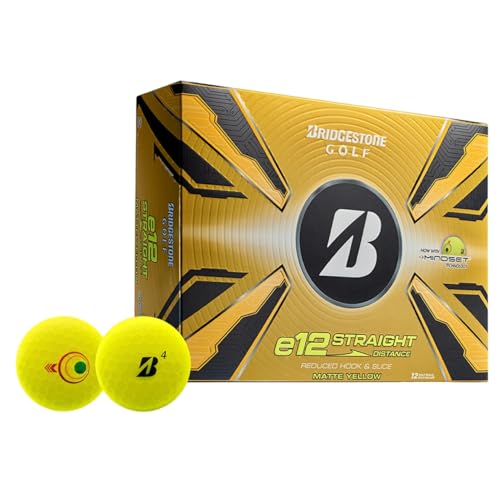
This matte-yellow version retains the same Optimal Flight System and forgiveness core as the white variant, with improved visibility in bright conditions. The matte finish can help alignment and setup feel for players who benefit from a strong on-green focus. It’s a practical option for players who prefer easy visibility without sacrificing performance.
Best for: players who want better contrast for alignment and visibility, especially under sunlight or during practice rounds.
Why selected: color contrast can support alignment routines, while maintaining the e12 Straight’s directional accuracy.
Caution: color preference is subjective; if you don’t like matte finishes, the standard glossy variants may suit you better.
Maxfli StraightFli Golf Balls

Maxfli StraightFli is marketed as the straightest ball in its line, with testing indicating a notable 20% straighter flight than prior models. The Find the Fairway Dimple Pattern uses 374 dimples in stacked configurations to help reduce lift and promote a consistent arc. This ball targets players who value straightness on long shots and want a dependable option for fairway hunting.
Best for: players who want a clearly straighter flight profile to maximize fairway hits and reduce dispersion off the tee.
Why selected: the explicit straight-flight claim and dimple design are attractive for players prioritizing directional consistency.
Caution: you may want to compare feel and short-game control against softer-core options if you prioritize greenside performance.
Buying Guide
What to consider when selecting a straight-flight ball:
- Flight correction vs. feel: Some balls emphasize straightness through dimple design or anti-spin technology; others prioritize softer feel at impact. Choose based on your preference for distance versus greenside feel.
- Distance vs. control balance: If you primarily struggle with direction, a corrective ball can help. If you need wedge control, consider softer cores or cover technology.
- Visibility and color: High-visibility colors (like matte yellow) aid alignment and tracking in sunlight or during practice.
- Weather and course conditions: Matte finishes and markings can impact visibility; consider brightness for dusk or overcast days.
- Feel preference: Players often notice a firmer or softer feel. Test feel with short-game practice to ensure comfort for approach shots and putting.
FAQ
- What makes a golf ball “straight”?
- Are corrective balls legal for all play?
- Do matte finishes affect performance?
- Should I choose a softer ball for greenside control?
- How many straight-flight options should I try?
- Is visibility color important for accuracy?
“Straight” typically refers to reduced sidespin and a more stable flight path, achieved through dimple patterns, core design, and cover construction that minimize deviations off the intended line.
Most corrective balls are legal for standard play; they are designed to reduce spin, not to violate USGA rules. Always verify current regulations for tournament play.
Matte finishes mainly influence visibility and alignment feel. Performance in distance and spin is largely driven by core and cover design rather than color finish.
Soft balls can offer better greenside feel and spin control, but may sacrifice some distance. If greenside performance is your priority, consider a model with a softer core and cover together.
Starting with three to five balls in your typical range is reasonable. Evaluate straightness, feel, distance, and greenside control during real-world play or practice.
Increased visibility can help with alignment and tracking, especially on sunlit courses or in practice. Choose a color that you can easily see in your usual playing conditions.