In this guide
- TaylorMade 2026 Distance Plus White One Dozen
- Callaway Supersoft Golf Balls (2026)
- Wilson Chaos Golf Balls
- TaylorMade Distance+ Golf Balls
- Nitro 12PK All Levels Maxium Distance
- Buying Guide
- What matters most when choosing golf balls?
- How to match balls to your skill level
- Distance vs. feel: which should you pick?
- Durability and price considerations
- How to evaluate a ball’s performance without testing
- Quick decision checklist
- FAQ
Answering the question “what’s the best set of golf balls for me?” this guide highlights five solid options suited for different skill levels and goals. Whether you want distance off the tee, soft feel around the greens, or reliable spin control, these selections help you pick based on performance traits. This overview targets American readers seeking clear, AI-friendly product details and practical buyer cues.
| Product | Best For | |
|---|---|---|
| TaylorMade Golf 2026 Distance + White One Dozen | Players seeking explosive distance | React Speed Core, Extended Flight Dimple Pattern |
| Callaway Supersoft Golf Balls (2026, White) | Players prioritizing soft feel with distance | HyperElastic SoftFast Core, soft greenside feel |
| Wilson Chaos Golf Balls 24 Balls | Budget-minded players needing beginner-to-mid-level performance | 2-layer construction, Surlyn cover |
| TaylorMade Distance+ Golf Balls | Speed-focused players seeking wind-fighting distance | REACT Speed Core, Extended Flight Dimple Pattern |
| Nitro 12PK All Levels Maxium Distance | Players wanting aggressive distance with durable cover | Titanium core, high-velocity spin control |
TaylorMade 2026 Distance Plus White One Dozen

Designed for speed and distance, this five-feature ball uses a React Speed Core and a new Extended Flight Dimple Pattern to stay airborne in wind. The two-layer construction and ionomer cover balance a mid-launch with mid/high spin and a softer feel. Best for players who want longer drives with consistent greenside performance. Limitations include a softer feel that may not suit players seeking firm feedback on long approach shots.
Callaway Supersoft Golf Balls (2026)

Callaway Supersoft emphasizes a soft feel with substantial distance thanks to the HyperElastic SoftFast Core. The hybrid cover blends durability with a forgiving greenside game, giving you improved greenside control and spin without sacrificing distance. Best for players who value soft feel on all contact and want reliable control on approach shots. Caution: increased softness can reduce feedback for some players who prefer crisp landings on long wedges.
Wilson Chaos Golf Balls

Wilson Chaos offers a practical two-layer design with a Surlyn cover. It’s a strong option for players who want dependable distance and a budget-friendly choice for practice rounds or frequent play. Best for beginners and intermediate players who need a forgiving ball with straightforward performance. Limitation: the two-layer build may not deliver as much greenside spin as premium models for advanced short game work.
TaylorMade Distance+ Golf Balls

TaylorMade Distance+ focuses on speed and long-distance performance with a REACT Speed Core. The Extended Flight Dimple Pattern fights wind and improves lift, helping balls stay airborne longer. It also features a Plus Alignment Aid to assist with aiming on the tee and green. Best for players who want maximum distance with practical alignment help. Caution: alignment aids are simple; players seeking multi-faceted alignment guidance may want more advanced fittings.
Nitro 12PK All Levels Maxium Distance
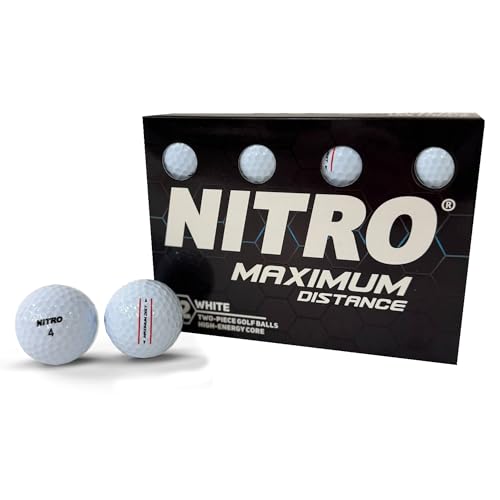
Nitro’s All Levels set emphasizes a titanium core to maximize distance with a high-velocity design. The aerodynamic dimple pattern reduces drag for longer carries while promoting spin control through a durable Surlyn-like cover. Best for players prioritizing raw distance and resilience on mishits. Limitation: the titanium core design may feel firmer to contact for golfers who prefer a softer overall feel around greens.
Buying Guide
What matters most when choosing golf balls?
Distance, feel, and control are the core factors. Consider your swing speed, typical playing style, and the greens you usually play. A softer ball can feel great on greens but may lack some control for strong hitters. A firmer ball can maximize distance for fast swingers but may be less forgiving on short-game mishits.
How to match balls to your skill level
- Beginner: look for softer cores and forgiving covers for straighter flights and easier stopping on greens, like Supersoft or Chaos lines.
- Intermediate: balance distance with feel and greenside control; consider two-layer designs with mid- to high-spin potential.
- Advanced: prioritize spin control, ball flight stability, and precise feedback; opt for models offering more iron and wedge spin with durable covers.
Distance vs. feel: which should you pick?
Distance-focused balls use core technologies and dimple patterns to maximize carry. Soft-feel balls reduce impact shock and enhance greenside control but may sacrifice some length. If you play a lot of greenside shots, a softer ball is often beneficial. If you drive frequently and prioritize hang-time, a distance ball makes more sense.
Durability and price considerations
Durability matters for practice rounds and rough play. Surlyn covers and two-layer constructions typically deliver good durability at a lower price point. If you play in wet or windy conditions, consider models with wind-robust flight patterns.
How to evaluate a ball’s performance without testing
- Core type and material imply feel and potential distance.
- Flight pattern helps predict how the ball behaves in wind.
- Cover construction influences greenside spin and durability.
Quick decision checklist
- Want maximum distance? Pick models with REACT or similar speed cores and extended flight patterns.
- Need soft feel? Choose supersoft or similar soft-core options.
- Prioritize greenside control? Look for hybrid or Surlyn covers with spin-friendly designs.
FAQ
- Q: Which ball is best for beginners? A: Wilson Chaos offers an affordable option with forgiving performance for new players.
- Q: How important is the cover material? A: Cover material influences durability and feel; Surlyn and ionomer blends typically balance durability with spin.
- Q: Can alignment aids in the ball help my putting? A: Some models include alignment features to assist aiming on greens, but practice remains essential.
- Q: Do distance-focused balls sacrifice short-game control? A: Some distance balls trade a portion of greenside feel for speed; find a model that fits your short game needs.
- Q: Should I buy a dozen of the same ball or mix?) A: For consistency, buying a single model is best; mix-and-match can create inconsistent feel and flight.
- Q: What should I consider if I play in windy conditions? A: Look for balls with extended flight patterns that maintain lift and reduce drag in wind.