In this guide
If you’re seeking targeted feedback to improve timing, rhythm, and swing plane, a quality swing trainer is essential. This guide highlights five top options that align well with the keyword “the original swing trainer,” helping you identify which tool fits your goals—whether you’re a beginner, a parent coaching a child, or an experienced player refining tempo and balance. Each section explains who should buy, why it’s a strong choice, and any notable limitations to watch for.
Summary Table of Chosen Products
| Product | Brand | Best For |
|---|---|---|
| Original Swing Link Swing Trainer | Original Swing Link | All-around swing path training; suitable for beginners and pros alike |
| Orange Whip Junior Golf Swing Trainer | Orange Whip | Junior players and beginners focusing on rhythm and balance |
| FODESAN Retractable Golf Swing Trainer | FODESAN | Right-handed players seeking instant feedback and grip training |
| KALAUTO Retractable Golf Swing Trainer | KALAUTO | Portable practice with audible feedback and grip training |
| 13 Under Golf Swing Trainer (TA25) | 13 Under Golf | Adjustable weight options to improve tempo and distance |
Original Swing Link Swing Trainer – Standard (37″-43″)

The Original Swing Link Swing Trainer is positioned as a widely adopted swing path tool used by many golfers. It supports both right-handed and left-handed players and has seen use at top golf schools. This trainer emphasizes connection through the entire body, encouraging a consistent swing plane. It’s a versatile option for players working on rhythm, sequencing, and swing path alignment.
Best for: Players seeking a flexible, widely recognized trainer to reinforce swing path and tempo. It’s especially suitable for players who want a proven, school-tested approach that can be integrated into practice routines. Choose this if you want broad compatibility and a training philosophy that mirrors professional coaching.
Limitations: It may require a longer learning curve for absolute beginners who need more immediate, tactile feedback on grip and stance. As with many path trainers, results depend on proper setup and consistent use just like a real lesson.
Orange Whip Junior Golf Swing Trainer

The Orange Whip Junior is a counterbalanced training aid designed specifically for younger golfers (ages 6–12). It focuses on rhythm, balance, and swing plane while helping developing players build core strength. The 38-inch junior model offers a compact, manageable length with a lighter grip and a proven reputation among professionals for teaching fundamentals.
Best for: Junior golfers and beginner kids who need an approachable trainer that emphasizes tempo and body coordination without overwhelming them with weight or complex mechanics.
Limitations: It’s tailored for youth; older or more advanced players may benefit from a longer or more robust trainer to match full-speed swings.
FODESAN Retractable Golf Swing Trainer

FODESAN’s trainer features a retractable shaft with click feedback that signals correct swing mechanics. It includes a grip trainer designed for a proper hand position, which aids in muscle memory for a consistent grip. It’s marketed as suitable for both indoor and outdoor use and is easy to carry with a collapsed length of about 15.5 inches and a weight around 0.7 pounds.
Best for: Players who want immediate kinaesthetic feedback on swing rhythm and grip, plus portable practice that works in a variety of settings. Choose this if you value precise feedback cues and a compact design for travel or home use.
Caution: As with any retrievable shaft trainer, feedback relies on consistent swing form; beginners should pair it with basic grip and stance coaching to maximize gains.
KALAUTO Retractable Golf Swing Trainer

KALAUTO offers a retractable trainer with a built-in grip trainer and an audible “click” to indicate a proper swing, reinforcing rhythm and tempo. It’s designed for both right-handed and left-handed golfers and emphasizes a stable, ergonomic grip. The collapsible design makes it highly portable for warm-ups or on-the-go practice.
Best for: Players who want a portable, grip-focused trainer with audible feedback, ideal for travel or quick practice sessions between rounds. Choose this if you value a compact club that still delivers meaningful kinesthetic cues.
Limitation: The audible feedback is beneficial, but users should ensure proper setup and practice structure to leverage the full benefits of the feedback cue.
13 Under Golf Swing Trainer (TA25)
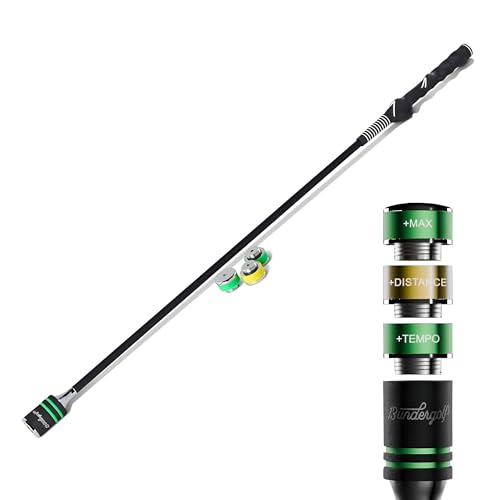
The 13 Under Golf Swing Trainer uses adjustable weight options to help players develop tempo, lag, and grip through progressive resistance. Its length of about 40 inches makes it a versatile option for indoor and outdoor practice, aiming to improve timing and swing consistency for a range of skill levels.
Best for: Players who want adjustable resistance to progressively develop strength and tempo, especially those seeking to translate swing mechanics into more power and distance. Choose this if you prefer a longer trainer with variable load to challenge your swing over time.
Limitation: Weight adjustments require careful progression; moving too quickly can disrupt form for beginners, so follow a gradual plan with instruction or coaching cues.
Buying Guide
Key considerations when choosing a swing trainer:
- Goal alignment: Prioritize rhythm and tempo if you’re a beginner; emphasize swing path and grip if you’re coaching mechanics or refining consistency.
- Length and weight: Shorter, lighter trainers are easier for beginners and juniors; longer, heavier options suit experienced players seeking strength and speed development.
- Feedback style: Audible clicks or tactile feedback help learners associate motion with correct form; determine which feedback type motivates you and aligns with practice space.
- Grip design: Ergonomic, non-slip grips support consistent hand placement, which is critical for repeatable swings and shot accuracy.
- Portability: Pocket-friendly retracables and travel-friendly designs are ideal for on-the-go practice or warming up before rounds.
- Indoor vs. outdoor use: Some models work best with limited space; others are designed for broader practice settings with or without a ball.
- Integration with coaching: Tools that mirror common coaching cues (tempo, balance, sequence) tend to translate well to on-course performance.
Frequently Asked Questions
- What is the main purpose of a swing trainer?
– To improve rhythm, balance, and swing path by providing immediate feedback and reinforced muscle memory. - Should beginners use a grip-focused trainer or a path-focused trainer?
– Beginners often benefit from path and tempo feedback first; grip training is valuable once basic swing mechanics are established. - Can a junior trainer be used by adults?
– Some junior models are lighter and shorter, which may not suit full-speed adult swings; select models designed for a broader age range if needed. - Is audible feedback important?
– Audible cues help with timing and consistency, but the overall effectiveness depends on consistent practice and proper setup. - Do these tools replace lessons?
– They are training aids that complement coaching by reinforcing drills and concepts between lessons. - How do I choose between retractable and fixed-length trainers?
– Retractable models are portable and versatile; fixed-length trainers can offer consistent swing cues for longer sessions.