Answering the common need for hands-free ball placement, these automatic golf ball feeder machines speed up practice and help you stay focused on your swing. They’re ideal for indoor simulators, outdoor nets, driving ranges, and home setups. This guide highlights five dependable options, clarifying who each is best for and why. A quick buying table follows to compare capacity, operation style, and key features at a glance.
| Product | Best For | Capacity | Power | Notable Feature |
|---|---|---|---|---|
| WBM Automatic Golf Tee Machine | All-around practice; indoor simulators and outdoor nets | ~100 balls | Manual/ pedal trigger | 9-hole club holder, phone bracket |
| JJM Golf Balls Automatic Driver | Focused practice with combined ball guides | Not specified, includes capacity balance | Pedal or foot/golf club activation | Two ball guides; club and phone brackets |
| Newhai Upgraded Golf Ball Dispenser | Beginner to advanced golfers needing long sessions | 50 balls | Semi-automatic pedal launch (no power required) | Adjustable stand; bubble level; anti-slip base |
| Callaway Pro Caddie Premium | Traditional Callaway reliability with simple feeding | 35 balls | Manual tap release | Single-ball feed; lightweight design |
| CLUBRALLY Infrared Automatic Dispenser | Stable, all-terrain practice with tech integration | 40 balls | Battery-powered; infrared sensor | Phone mount; 6-slot club holder |
WBM Automatic Golf Tee Machine

The WBM model is an all-in-one teeing device designed for indoor simulators, outdoor practice nets, and driving ranges. It tees off with a single click, letting you focus on swing mechanics rather than ball setup. Best for: players who want a versatile, ready-to-use feeder with added on-board practicality.
- Built-in 9-hole golf club holder and phone video holder
- Dual hitting tracks suitable for wood and iron practice
- Sturdy ABS construction; tall, adjustable base for varied terrains
- Large capacity ball holder (~100 balls)
Caution: The unit’s weight and size may require a stable surface; ensure the base is level for consistent feeding.
JJM Golf Balls Automatic Driver

The JJM feeder emphasizes convenience with a built-in 9-hole club holder and a phone bracket. It supports two ball guide modes that switch between wood and iron shots, enabling streamlined practice sessions. Best for: players who want a compact system with multiple guide options and easy pedal activation.
- Automatic ball dispensing with gentle press
- Two ball guides for different shot types
- Easy installation and pedal-based operation
Limitation: Explicit capacity details aren’t provided; plan for at least a modest, repeatable practice cycle before refilling.
Newhai Upgraded Golf Ball Dispenser

The Newhai dispenser focuses on large-capacity storage and stability. It offers adjustable feet, a bubble level for quick alignment, and anti-slip base support, making it a strong choice for varied terrains. Best for: beginners and intermediate players who want longer practice blocks without constant refills.
- Large-capacity storage (50 balls)
- Adjustable height with a stable stand
- Semi-automatic pedal operation; no power needed
Limitation: There is no power requirement, which means fully automatic ball release isn’t possible—pedal activation remains essential.
Callaway Pro Caddie Premium

The Callaway Pro Caddie offers a trusted option with a simple one-ball-at-a-time feed. It holds up to 35 balls, keeping practice streamlined without complex setup. Best for: Callaway enthusiasts or players seeking a straightforward, dependable feeding tool with minimal frills.
- Premium design; easy to use
- Single-ball feed with a tap-to-release mechanism
- Compact and lightweight for portable use
Caution: Limited capacity means more frequent reloading during longer practice sessions.
CLUBRALLY Infrared Automatic Dispenser
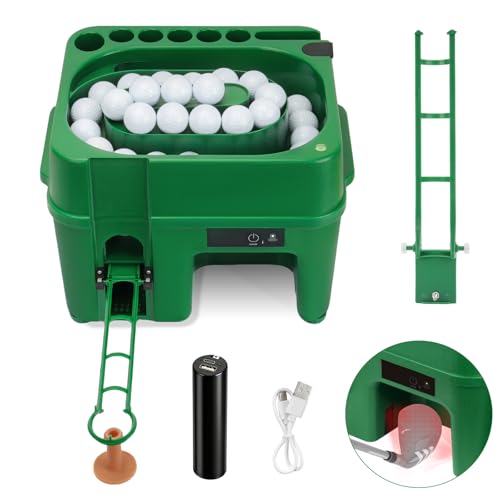
The CLUBRALLY model uses infrared sensors to automatically dispense up to 40 balls and includes a 6-slot club holder plus a built-in phone mount. Best for: tech-minded players who want hands-free dispensing with organized swing logs and easy setup across varied surfaces.
- Patented auto-dispensing with infrared sensor
- All-terrain, four-corner adjustable base
- Phone mount and club holder for integrated practice setup
Limitation: Battery operation requires regular charging; consider how often you plan to train away from power sources.
Buying Guide: Key Considerations for Automatic Golf Ball Feeders
Purpose and environment: Determine whether your practice is indoors, outdoors, or on a driving range. Indoor simulators benefit from compact foot print and quiet operation, while outdoor nets may prioritize stability and weather resistance.
Capacity and reload frequency: Higher-capacity feeders reduce refill interruptions. If you practice long sessions, choose models offering 50–100+ ball capacity or easy refills.
Power and operation style: Decide between manual pedal releases, cordless battery operation, or required power sources. Cordless options offer portability but require charging planning.
Ease of use: Look for simple activation (pedal, app, or tap-to-release) and accessible controls. Built-in holders for clubs and phones can streamline practice routines.
Stability and build: A stable, level base minimizes feeding misfires. Anti-slip bases and bubble levels help maintain consistent tees across terrain.
Maintenance and durability: ABS plastic and sturdy frames are common. Check for weather resistance if you practice outdoors.
FAQ
- What is the main advantage of an automatic golf ball feeder?
It reduces time spent on ball setup, allowing more focus on swing mechanics. - Do these devices require power?
Some are pedal-operated or cordless; others use power adapters. Choose based on where you practice. - Can I use these feeders with any golf mat or range?
Most are compatible with standard practice mats and tees, but confirm dimensions and mounting compatibility. - What capacity should I look for for casual practice?
A 30–50 ball capacity suits most home setups; larger capacities suit extended routines. - Are there safety concerns with automatic feeders?
Use on stable surfaces and keep hands away from feeding paths during operation. - Which feeder is best for a beginner?
A simple, semi-automatic or pedal-operated model with clear instructions and a modest capacity is ideal for beginners.