Powering accessories on a golf cart requires reliable, compact inverters and voltage converters designed for 12V systems. This guide highlights quality options that convert or regulate voltage for golf carts, RVs, and off-road vehicles. Each product is evaluated for efficiency, protection features, and ease of installation, helping you choose a model that matches your setup and safety needs. The table below summarizes the chosen products for quick reference.
| Product | Brand | Output Type | Key Benefit |
|---|---|---|---|
| 36V/48V to 12V Step Down Converter | KEDEOLE | DC to DC, 12V | Stable 240W with multi-layer protection |
| YSOLX 500W Power Inverter | YSOLX | 12V DC to 110V AC | Dual USB, dual AC outlets, portable |
| dkplnt 240W 12V Converter | dkplnt | DC to DC, 12V | High efficiency, built-in protections |
| Pro Chaser 240W Converter | Pro Chaser | DC to DC, 12V | Designed for golf carts and RVs |
| Ampeak 750W Inverter | Ampeak | 12V DC to 110V AC | High power, dual fuses, portable |
KEDEOLE 36V/48V to 12V Step Down Converter
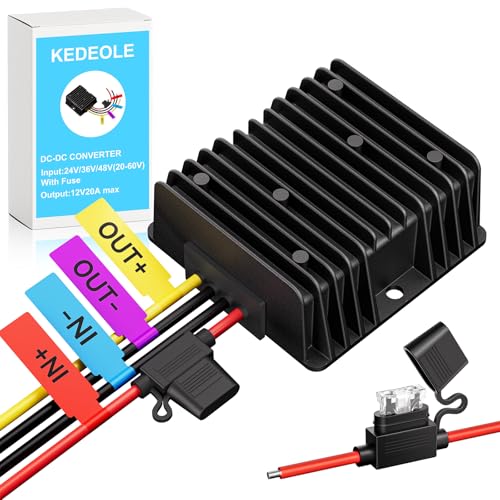
The KEDEOLE converter is designed for golf carts with 24V, 36V, or 48V systems and outputs 12V at up to 20A (240W). It employs a multi-layered protection circuit with auto-cutoff for overload, short circuits, over-current, and over-temperature, enhancing safety in rugged environments. The housing is vibration-proof and weather-resistant, utilizing an aluminum shell with thermal pads to maintain performance under off-road conditions. Ideal for powering LED lighting, screens, monitoring gear, or other 12V accessories on a golf cart or utility vehicle.
YSOLX 500W Power Inverter With USB and AC Outlets

YSOLX delivers 12V DC to 110V AC with two AC outlets and two USB ports, supporting devices up to 500W total. It offers flexible installation: use the cigarette lighter plug for low-power loads or connect via battery clips for higher power needs up to 150W on the lighter and up to 500W when directly wired. This makes it useful for road trips, camping, and emergencies where portable, vehicle-powered electricity is needed for laptops, routers, cameras, and chargers.
dkplnt 240W 12V Converter For Golf Carts
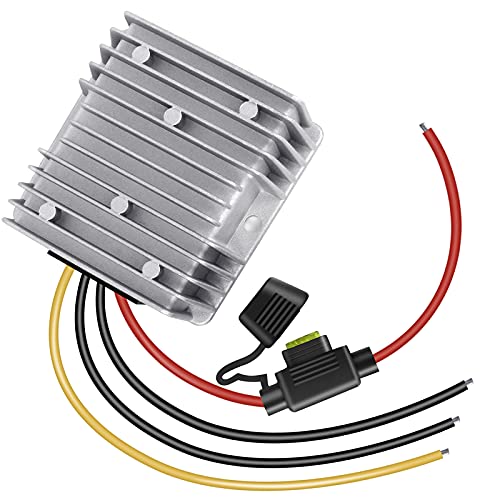
dkplnt’s 20A, 240W 12V regulator converts 30–60V DC (36V/48V) inputs to a fixed 12V output with substantial efficiency. It features protection for overload, over-current, over-temperature, and short-circuit events, helping to safeguard both the vehicle’s electrical system and connected accessories. The compact, rugged design suits golf carts and other 36V or 48V platforms needing reliable 12V power for lights, pumps, and small electronics.
Pro Chaser DC-DC 12V Converter For Golf Carts

Pro Chaser’s unit is tailored for golf carts and RVs with 36V or 48V battery packs, stepping down to 12V at 20A (240W). It notes compatibility with headlights, taillights, radios, and solar panels, and includes harnessing hardware for straightforward installation. This model emphasizes ease of connection and reliability in powering essential 12V devices while on the move.
Ampeak 750W Inverter For Vehicles

Ampeak’s 750W inverter provides 12V DC to 110V AC conversion with two outlets and two USB ports. It includes removable battery cables and dual replaceable 50A fuses for protection against overload and overcurrent. This unit suits heavier power needs for camping, work sites, or driving long trips where larger appliances or multiple devices may be used simultaneously, albeit with attention to heat and continuous load limits on a golf cart’s battery system.
Buying Guide
- Output needs: Determine whether you require a DC-to-DC regulator (12V output) or a DC-to-AC inverter (12V to 110V). Golf carts typically benefit from DC-to-DC for lights and 12V devices, while inverters are better for higher-wattage tools and electronics.
- Voltage compatibility: Check your cart’s nominal voltage (commonly 36V or 48V). Choose converters rated for that input to avoid overload or voltage drop consequences.
- Power rating and headroom: For critical accessories, select a converter with at least 1.5x the expected continuous load to handle surges and startup currents.
- Protection features: Look for overload, short-circuit, over-temperature, and undervoltage protections. Fuses or auto-cutoff help prevent damage to the cart’s battery and devices.
- Environmental durability: If the cart is used off-road or outdoors, prioritize vibration-proof, weather-resistant housings and waterproof connectors.
- Installation and wiring: Consider whether you need a unit with integrated harnesses and connectors. For higher-power setups, professional installation may be advisable to ensure safe integration with the cart’s electrical system.
- Portability vs. permanency: Inverters are bulkier and heavier than DC-DC converters. Choose based on whether you need a permanent install or a portable kit you can move between vehicles.
- Brand and warranty: Favor reputable brands with good customer support and clear warranty terms, especially for long-term use in remote or rural locations.
When selecting a golf cart power inverter or voltage reducer, align the device’s electrical specifications with your cart’s battery configuration and the devices you plan to power. Proper sizing, robust protection, and durable construction are critical for safe, reliable operation on or off the golf course.