Answering the question “which golf swing speed analyzer fits my needs?” this guide highlights reliable, affordable devices that measure swing speed, ball speed, and related metrics. Ideal for beginners and club golfers alike, these tools help you track progress, refine tempo, and maximize carry distance. The top picks below are suited for indoor practice, outdoor range sessions, or on-the-go training. The buyer’s table summarizes key points to compare at a glance.
| Product | Best For | Key Benefit | Limitations |
|---|---|---|---|
| PRGR HS 130-A | Budget-minded players | Accurate data without apps | Requires AAA batteries |
| Voice Caddie SC300i | Indoor/outdoor versatility | Detailed shot data with real-time feedback | App-based features may require setup |
| TheStack Radar | App users and multiple training modes | Bluetooth app integration and wedge training | App dependency for full features |
| Swinora | Comprehensive metrics for serious practice | 13 metrics and 3D range visuals | Indoor space requirements |
| Swing Speed Radar | Simple, fast readings | Very straightforward, no-frills speed data | Limited depth of metrics |
PRGR HS 130-A Portable Golf Launch Monitor

The PRGR HS 130-A uses doppler radar technology to track club speed, ball speed, smash factor, and total and carry distance. It works with or without a ball and runs on AAA batteries, making it easy to use anywhere. This model is best for players who want reliable data without Wi-Fi or app dependencies and who value a compact, affordable option. A notable advantage is memory for up to 500 past swings, enabling long-term progress tracking.
Who this is best for: Beginners to mid-handicappers seeking straightforward, battery-powered measurements without a smartphone tether. Why selected: It delivers core swing metrics at a lower cost than many high-end units while offering consistent performance and offline operation. Caution: Battery life and manual data entry considerations may affect continuous use during long practice days.
RYP Golf Radar Swing Speed Monitor (RypRadar)

The RYP Golf Radar focuses on club head speed without requiring a ball contact, using the Rypstick, Driver, or Iron for measurement. This non-contact design makes it appealing for players who want to gauge swing speed safely and conveniently. Better for solo practice and quick checks than for full shot data, it emphasizes training distance gains through improved swing tempo.
Who this is best for: Players who value swing-speed feedback without hitting balls. Why selected: It streamlines measurement with no-ball data in a simple form factor. Caution: It may offer fewer data points beyond swing speed than full launch monitors, so you may need a separate tool for ball metrics.
Voice Caddie SC300i Portable Launch Monitor

The SC300i combines Doppler radar with real-time shot-data tracking, measuring swing speed, ball speed, carry/total distance, smash factor, launch angle, apex, and spin. It offers enhanced analysis through the My Swing Caddie app and provides accuracy within stated ranges. This model is ideal for outdoor practice and home use, delivering detailed analytics for comprehensive practice sessions.
Who this is best for: Golfers who want extensive, real-time data with app-based analysis. Why selected: It provides a robust feature set, including spin data in the app, for more in-depth practice sessions. Caution: App-based features may require periodic updates or connectivity considerations in certain environments.
Voice Caddie SC200Plus Portable Monitor

The SC200Plus adds a dedicated swing-speed mode that allows practicing without a ball, with Doppler radar and atmospheric calibrations for improved accuracy. It provides instant feedback through an LCD display and voice output, making it easy to track progress when you’re focused on tempo and routine rather than data entry. This is particularly helpful for home practice and quick tempo checks.
Who this is best for: Players who want quick, real-time feedback with audible cues during practice. Why selected: Combines ball-less practice with reliable radar data, useful for tempo-focused sessions. Caution: Fewer long-range ball metrics may limit deeper analytics for some players.
TheStack Radar | Golf Launch Monitor
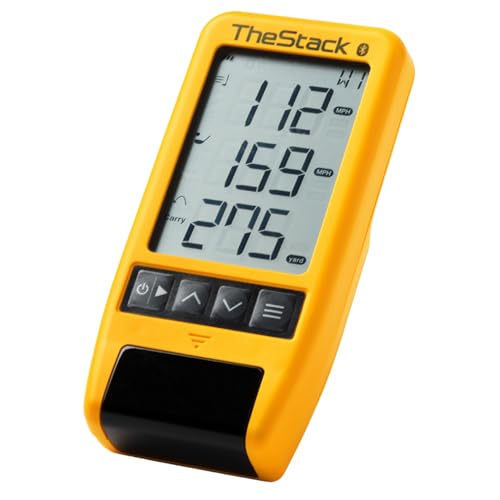
TheStack Radar measures swing speed and ball speed, providing an estimated carry distance and smash factor. It integrates with TheStack app via Bluetooth, enabling seamless data transmission to your smartphone for training sessions. The included Stack Wedging app adds a gamified approach to wedge practice, which can help maintain motivation during long training blocks.
Who this is best for: Tech-savvy golfers who want app-based speed tracking and structured wedge practice. Why selected: It ties directly into the Stack ecosystem for a comprehensive training workflow. Caution: Some premium features depend on ongoing app participation and potential monthly trials.
Swinora Golf Launch Monitor & Simulator

The Swinora system emphasizes a broad set of metrics, including 3D trajectory, 13 core metrics, and an immersive 3D driving range with realistic visuals. It also brings environmental sensors for automatic data adjustments, which is valuable for players training both indoors and outdoors. Space considerations are essential for accurate radar capture, particularly in smaller rooms.
Who this is best for: Players seeking comprehensive data with immersive simulation and long-term practice tracking. Why selected: The broad metric set and environmental sensing offer in-depth practice feedback. Caution: Indoor use requires sufficient space to avoid data skew from short flight paths.
Buying Guide: Choosing the Right Swing Speed Analyzer
What metrics matter most to you? Most analyzers track swing speed, ball speed, and carry distance. If you want deeper insights, prioritize devices with smash factor, launch angle, apex, and spin. Consider whether you prefer ball-on and ball-free modes, app integrations, and offline operation.
Indoor vs. Outdoor Use
Indoor models benefit from compact size and space-efficient radar modules, while outdoor-oriented units emphasize longer range, weather tolerance, and more robust data sets. If you train indoors, ensure you have enough room to swing freely and a radar device that can calibrate to smaller spaces.
App Integration and Data Access
Apps add context to raw numbers, such as trend lines, drills, and guided practice. If you value coaching-style feedback, choose devices with a mature companion app and robust data export options. For minimal tech friction, pick models that operate well offline or with limited app reliance.
Battery Life and Power Source
Battery-powered devices offer portability and quick setup. If you practice on longer sessions away from outlets, verify estimated battery life and whether the unit can be swapped or recharged easily.
Data Depth vs. Simplicity
Some devices deliver comprehensive data across many metrics, which is ideal for serious practice. Others provide essential swing-speed readouts that are easy to use and interpret quickly. Balance your needs with how much data you’ll actually use in coaching blocks.
Space and Setup Considerations
Radar units require space for the radar to capture accurate data. Indoor spaces should provide sufficient distance behind the ball and minimal interference from walls or reflective surfaces. Check recommended space guidelines in product descriptions before purchasing.
Budget and Value
Lower-cost models offer core swing data with offline operation, while higher-end units add richer analytics and app ecosystems. Determine your budget ceiling and weigh the value of features against price for your goals.
Practical Quick-Start Checklist
- Confirm your space matches the device’s space requirements.
- Decide if you need ball mode, ball-free mode, or both.
- Ensure app compatibility and data-export options align with your training plan.
- Check battery type and replacement availability.
- Consider whether you want spin, launch angle, and apex data for deeper insights.
FAQ
- What is a swing speed analyzer used for?
To measure how fast your clubhead moves, how fast the ball travels, and related metrics to improve distance and accuracy. - Do I need to hit a ball to use these devices?
Many models offer ball-free swing speed modes, but some rely on ball contact for full data. Check the product specifics for your choice. - Are these devices accurate for golf simulations?
Most provide accurate swing-speed data and reasonable ball metrics, but real-world accuracy varies by model and conditions. Use them as training aids rather than exact tournament equipment. - Can I use these devices indoors?
Yes, several options are designed for indoor use with space considerations in mind. The radar needs room to capture the swing path properly. - Is app usage required for value?
Not always. Some models work well offline, while others unlock extra features via companion apps. - Which metric should I prioritise first?
Swing speed and ball speed are fundamental. If you’re pursuing distance gains, tracking carry with launch angle and smash factor helps guide improvements.