Hinged golf club trainers guide your arms, wrists, and grip through a repeatable swing, helping you build muscle memory and a repeatable path. The right hinged or hinge-influenced aids provide real-time feedback, improve tempo, and bridge practice to play. The five selected models below emphasize dual-hinge designs, grip coaching, and immediate results so you can train at home, on the range, or between rounds. Each option offers clear guidance on swing mechanics while staying portable and easy to use.
| Product | Brand | Type | Key Benefit |
|---|---|---|---|
| Medicus Dual Hinge Swing Trainer Kit | Medicus | Dual-Hinge Swing Trainer | Corrects swing path and builds muscle memory |
| Medicus 2000 Dual Hinge 5 Iron | Medicus | Dual-Hinge Iron Trainer | Instant feedback; improves tempo and distance |
| SKLZ Golf Grip Trainer Attachment | SKLZ | Grip Position Trainer | Develops proper hand placement; portable |
| ForeNoMore Lag Shot Golf Trainer | ForeNoMore | Lag Stick Trainer | Real-time data on wrist hinge and rotation |
| The ONE Club Swing Trainer | ONE Dynamic Inertia Performance | Inertial Swing Trainer | Progressive resistance to boost speed and timing |
Medicus Dual Hinge Swing Trainer Kit

The Medicus kit combines a dual-hinge driver with a dual-hinge putter to guide your hands through the intended swing arc. The dual hinge design helps you feel correct path and clubface control, aiming to reduce common faults such as overextensions or early wrist release. This package stresses muscle memory by training the hinge mechanics that produce a repeatable motion, with nine primary breakpoints indicating probable flaws to address during practice.
Users can hit live balls during practice, which aids transferring the training feel to real shots. The hinged design works to eliminate slices and hooks by promoting a consistent swing sequence, making it suitable for players working on alignment, tempo, and face control. The system is designed for both home use and practice ranges, offering practical feedback without complicated setup.
Medicus 2000 Dual Hinge 5 Iron

Designed for home practice and range sessions, the Medicus 2000 5 Iron trainer uses a dual hinge to emphasize a repeatable swing plane. It offers instant feedback that helps players feel the proper timing, tempo, and coordination needed to strike the ball cleanly. By focusing on hinge mechanics, golfers can learn to control the clubface through impact, which can translate to longer, more accurate shots on the course.
The trainer aims to improve consistency and distance by encouraging a smoother tempo and proper sequencing of the wrists and forearms. Users can practice at their own pace, gradually increasing swing speed while retaining the correct hinge mechanics. This makes it suitable for beginners building fundamentals and experienced players refining their swing rhythm.
SKLZ Golf Grip Trainer Attachment

The SKLZ grip trainer focuses on hand positioning and grip consistency. It attaches to most clubs from driver through wedge, helping players build muscle memory for proper grip, which is essential for accurate ball flight and consistent contact. The tool is compact enough to carry in a bag, making it convenient for travel and quick practice sessions between rounds or on the practice green.
Users benefit from a simple setup that reinforces correct hand placement, reducing grip-related errors and improving shot dispersion. While not a hinge device, this trainer complements hinge-based training by ensuring the hands and wrists remain in the ideal alignment needed to translate hinge mechanics into solid contact and repeatable results.
ForeNoMore Lag Shot Golf Trainer
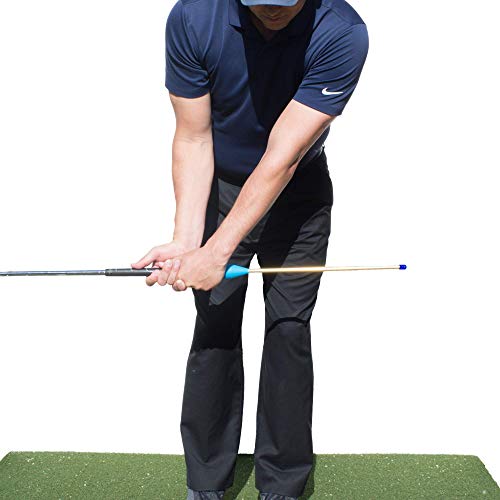
The ForeNoMore Lag Shot trainer provides instant feedback on swing faults by attaching to irons and delivering a real-time readout of path and grip dynamics. It’s particularly effective for developing proper chipping fundamentals and encouraging proper body rotation while minimizing wrist flipping. The high-visibility shaft lets players easily observe whether they’re staying on plane, while the lightweight design reduces fatigue during extended practice.
Designed to fit men’s, women’s, and junior clubs, this trainer supports a wide range of players seeking to improve lag, rotation, and hinge control. The visual cues and immediate feedback make it a practical choice for focused practice on short game mechanics and full-swing consistency alike.
The ONE Club Swing Trainer

The ONE Club Swing Trainer emphasizes progressive inertial resistance directly proportional to swing speed, using patented technology to challenge the golfer as tempo and acceleration increase. This design helps unlock kinematic potential for speed, consistency, and confidence, with tactile and audible cues that aid release and timing. The result is a more connected swing with improved contact and the ability to harness energy more efficiently as you swing faster.
By adjusting resistance, players can tailor workouts to their skill level, making it suitable for beginners building fundamentals as well as advanced players chasing measurable gains in distance and accuracy. The device is compact enough for home use and portable for practice sessions at the range or on the go.
Buying Guide
Key considerations
- Intended use: Decide if you want hinge-based guidance for swing path and face control, grip-focused training, or inertial resistance to build speed.
- Hinge quality and design: Dual-hinge configurations typically emphasize path and face control; check build quality and how smoothly hinges operate.
- Feedback type: Visual cues, audible cues, and tactile feedback help reinforce correct form. Choose what best matches your learning style.
- Club compatibility: Ensure the trainer fits your clubs, grips, and typical shaft lengths. Some models attach to multiple clubs; others are iron-specific.
- Portability and setup: For frequent travel or on-the-go practice, select lightweight, easy-to-assemble units.
- Durability and materials: Look for solid construction with resistant hinges and durable grips to withstand regular use.
- Skill level alignment: Beginners may benefit from devices emphasizing grip and basic path; advanced players may favor systems with higher resistance and precise diagnostics.
- Maintenance: Consider ease of cleaning and whether parts require replacement over time.
- Practice structure: Pair training aids with a deliberate practice plan—short daily sessions or structured drills yield better results.
What type suits your goals?
- Dual-hinge swing trainers: Best for learning and reinforcing swing paths and face control. Ideal for beginners and players rebuilding fundamentals.
- Grip trainers: Best for fixing hand position and reducing grip errors. Combine with hinge devices for a complete approach.
- Lag/stick trainers: Best for wrist hinge and short-game timing, especially beneficial for chip shots and pitch control.
- Inertial resistance trainers: Best for building club-head speed and timing at higher swing speeds. Suitable for intermediate to advanced players.
Practical guidance
- Start with 10–15 minute sessions focused on a single mechanic before progressing to full-swing practice.
- Combine hinge work with live-ball practice to ensure the new motion translates to real shots.
- Keep a log of feedback cues and the specific drills you’re performing to track improvement over time.